Study note
Brachial plexus organization and axillary anatomy
THE CONTEXT
The passage outlines the organization of the brachial plexus and several anatomical features of the axilla.
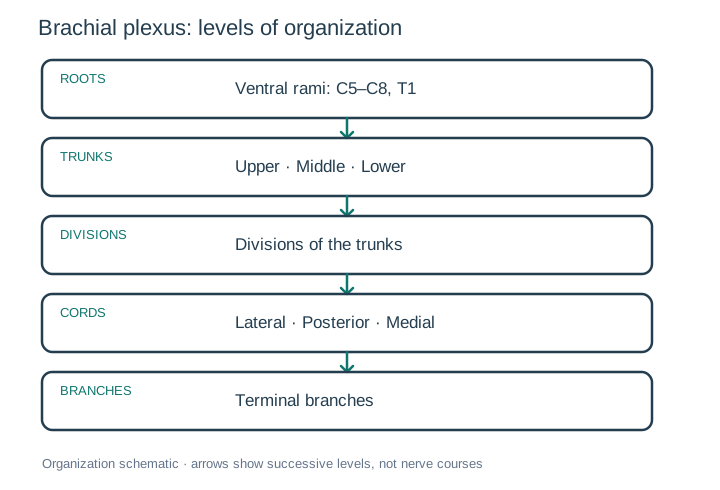
Successive levels of brachial plexus organization. This diagram shows organization rather than the anatomical course of nerves.
Organization of the brachial plexus
•
The lateral-to-medial branch sequence is musculocutaneous, axillary, radial, median and ulnar, recalled by “My Aunt Ragged My Uncle.”
•
The plexus is organized into roots, trunks, divisions, cords and branches.
•
The roots are ventral rami. The trunks are upper, middle and lower, and the cords are lateral, posterior and medial.
Axillary walls and passage
•
The sternoaponeurotic part of pectoralis major twists around the upper fibres of the same muscle, while latissimus dorsi twists around teres major. These arrangements form smooth anterior and posterior axillary walls.
•
The infraclavicular part of the brachial plexus lies in the axilla.
•
The apex of the axilla is the cervico-axillary canal, which transmits the axillary vessels and the lower part of the brachial plexus.
•
The axillary sheath is derived from prevertebral fascia.
Explore this chapter